
I Built a Baseline Marketing System in 30 Days: Here’s What Actually Happened


At the start of June, I made myself a promise: I was going to stop talking about a sustainable marketing system and actually build one.
Not a “someday” plan. Not another strategy doc that lives in a Google Drive folder collecting dust while I keep marketing other people’s businesses instead of my own. A real, repeatable, weekly system… the kind I tell my clients to build, that I had been very guilty of not fully building for myself.
So for 30 days, I committed to a baseline: one blog post a week, one newsletter a week, consistent Threads presence. I’d also get my Pinterest account up and running, and gear up for an Instagram comeback in July.
No skipping. No “I’ll catch up next week.” Just the system, every week, on repeat.
Here’s exactly what I did, what actually happened, and (because I promised myself I’d be honest about this) what flopped along the way.
The Baseline Marketing Plan I Committed To
I kept this intentionally simple, because the whole point was sustainability, not heroics. Here’s what the weekly rhythm looked like:
- One blog post per week, each one tied to a clear content pillar and fully optimized with a meta title, meta description, internal links, a real CTA
- One newsletter per week, sent every Tuesday, mixing personal storytelling with marketing insight
- Consistent Threads presence, multiple posts a day, mixing quick thoughts, behind-the-scenes moments, and reactions to what was happening in the industry
Three channels, one rhythm, repeated every single week for 30 days.
What Actually Happened: The Numbers
I want to be specific here, because vague “it went well!” recaps aren’t useful to anyone. Here’s where things landed by the end of June.

Blog:
- Total views on all blog posts/blog roll in June: 124
- Best-performing post: The Difference Between a Content Plan and a Marketing Strategy (And Why You Need Both)
In June, the blog pulled in 124 total views across all posts which sounds modest until you remember that I had literally zero blog views in April and only 41 in May. That’s a 200%+ jump in a single month, almost entirely from organic traffic to brand new content.
The best-performing post was The Difference Between a Content Plan and a Marketing Strategy which tells me that foundational, search-intent content is already doing exactly what it’s supposed to do.
For a blog that was essentially non-existent two months ago, this is a really encouraging baseline to build on!
Email:
- List growth: 16 new subscribers
- Newsletters sent: 8
- Average open rate: 60.31%
- Average click rate: 3.84%
- Highest-performing send: 📼 voice notes: vol. i
June was the first month all year that my subscriber count actually moved: 16 new subscribers brought my list to 102, which might sound small but is genuinely meaningful when you’ve been sitting at the same number since January!
More importantly, I sent 8 newsletters in June after sending a combined 3 in the entire first half of the year and the consistency paid off. My open rate held strong at 60.31% with a 3.84% click rate, but the metric I’m most proud of doesn’t live in a spreadsheet: I got more replies to my emails in June than I have in months.
The shift that made the difference was treating the newsletter less like a marketing broadcast and more like an actual conversation. I ran a month-long Voice Notes series that turned each send into something more personal and audio-driven, and watched what happens when you stop trying to be polished and just start being real.
Turns out people write back when you sound like yourself!!
Threads:
- Follower growth: 36 new followers
- Impressions: 55,200
- Interactions: 1,483
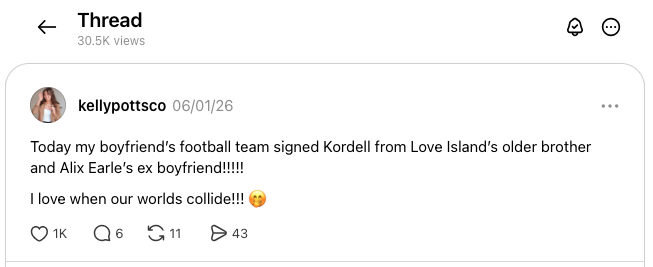
- Most-engaged post of the month: Me being a silly goose about my boyfriend’s world colliding with mine
Threads is where things get a little nuanced. May had a lil viral moment (a 15K steps post that sent overall monthly impressions into the 300K range) so on paper, June’s 55,200 impressions looks like a step back.
But context matters: June was a more intentional, offer-forward month with 36 new followers, 1,483 interactions, and a lot more consistent posting overall.
And the most-engaged post of the entire month? Not a marketing tip. Not a content strategy hot take. It was me being a complete silly goose about my boyfriend’s football team signing Kordell from Love Island’s older brother AND Alix Earle’s ex.
I’m still figuring out what I want my Threads strategy to look like, and how to drive meaningful, bottom-line engagement for my business from this platform. The lesson I’m taking into July: strategy matters, but personality is what actually makes people stay.
Across the board, the trend line was up
- A blog that didn’t exist two months ago is now pulling in consistent organic traffic
- An email list that hadn’t grown in six months added 16 new subscribers and an open rate that most email marketers would genuinely kill for
- A Threads presence that stayed active and intentional even without a viral moment to carry it
None of these numbers are going to land me on a Forbes list. But that was never the point. The point was proving to myself (and honestly, to you) that a simple, repeatable system, run consistently over 30 days, produces real and measurable momentum.
What Worked
A few things genuinely surprised me in the best way.
- Threads was the easiest win of the entire month. Low effort, high return. This became the channel where I felt the most real-time connection with people—replies, conversations, the occasional DM that turned into something deeper. If you’re looking for the lowest-lift place to start a consistency habit, this confirmed for me that Threads is it.
- Having a standing publish day for the blog removed so much decision fatigue. Knowing that blogs must be posted on Mondays meant I wasn’t negotiating with myself about when to write. The decision was already made. I just had to show up and do the work, which is a completely different mental experience than deciding from scratch every week whether “today is the day.”
- The newsletter became the thing I most looked forward to writing (and for the month of June, recording lol). As a former-journalist, I expected the blog to be my favorite, honestly. But there was something about the weekly rhythm of the newsletter, the more personal tone, and the direct relationship with the people reading it that made it the highlight of my content week by the end of the month.
- Repurposing actually worked the way I promise my clients it will. Each blog post fed Threads content, fed newsletter ideas, fed Pinterest pins. I wasn’t starting from scratch every day. I was starting from scratch once, and then translating that one idea across formats.
What Flopped (Because Honesty Matters More Than a Highlight Reel)
Here’s the part I think is actually more useful than the wins.
Pinterest was harder to stick with than I expected.
I went into June fully committed to making it a real channel, and I did show up there, just not as consistently as I wanted. What I underestimated was how much batch time Pinterest actually takes to do well. The pin copy, the descriptions, the graphics—when I missed one week’s batching session, the whole thing unraveled.
The fix I’m testing in July: one full dedicated day to batch and schedule the entire month at once, rather than trying to squeeze it into my weekly rhythm. Monthly Pinterest might actually be sustainable for how I work.
Blog Engagement
One thing the analytics flagged that I’m not going to pretend I didn’t notice: the average engagement time across the blog was 13 seconds. Which means some people are landing and not really reading, and that’s on me to fix.
My working theory is that it’s a combination of things: some posts need stronger opening hooks to earn the scroll, internal linking needs to work harder to keep people moving through the site, and honestly, some of those early posts were still finding their footing. I’m treating it as useful data rather than a verdict.
The posts that got real engagement time got it because the opening made someone feel something immediately and that’s the standard I’m holding myself to going forward.
Nerves Heading into July
This isn’t necessarily a flop, but something I want to be honest about as I head into July: three channels felt really good. Manageable, intentional, even enjoyable most weeks.
But I’m about to add in a high volume of Instagram posts and a more committed Pinterest presence—and I’d be lying if I said I wasn’t a little nervous about whether that’s actually sustainable for one person running a whole business solo.
The whole point of this experiment was to build something I could repeat without running myself into the ground, and adding two more significant commitments to the rhythm is a real test of that. I don’t have a tidy answer for this one yet. I’m going into July treating it as the next experiment and I’ll report back honestly on how it goes!
What This Marketing Plan Taught Me
The biggest thing I’m taking away from June isn’t a number. It’s the feeling of having actual proof—not just a theory, not just something I work on/create for my clients—that a simple, repeatable system produces real momentum when you actually run it.
I didn’t do anything revolutionary this month. No viral strategy, no secret formula, no posting at 3am because someone on the internet told me that’s when the algorithm rewards you. I just showed up, consistently, on the same channels, with a rhythm I could actually sustain and the numbers moved because of accumulation.
The other thing June taught me is that personal always wins. The Threads post that got 1K likes was about Love Island and my boyfriend’s football team. The emails that got the most replies were the ones that sounded the least like marketing emails. The blog post that performed best was the one that answered a question people are genuinely Googling. None of it was complicated. All of it was just me, showing up, being real, and trusting that the right people would find it. Turns out they do!
What’s Next
July is where the experiment gets interesting. I’m keeping everything that worked (the weekly blog, the weekly newsletter, the consistent Threads presence) and adding a high-volume Instagram push and a more committed Pinterest strategy into the mix.
I’m nervous about it, honestly, and I said so above. But I’m also excited, because if June proved anything, it’s that I actually like showing up when I have a plan underneath me.
I’ll be reporting back on how it goes: the wins, the misses, and whatever the data tells me I need to hear.
And if you’ve been reading this thinking okay but I want to build something like this for my own business—that’s exactly what Marketing HQ is for. It’s the $47 Google Sheet system that walks you through building your own version of exactly what I just did in June.
Enjoyed this post? You might also like:
→ What Sustainable Marketing Actually Looks Like (When It’s Working)
→ How to Stay Consistent With Your Marketing When Life Gets in the Way
Want to build a system like this for your own business?
→ Marketing HQ is the $47 Google Sheet system that walks you through building your own repeatable, sustainable content rhythm.


Hey! I’m Kelly
After 10+ years in the industry (and plenty of “why is this so hard?” moments), I’ve created a different way to market your business—one that puts your goals, energy, and capacity first.
My signature approach blends strategy with systems, structure with softness, and marketing with a lot more ease. I’m here to help you grow your business in a way that works for you because sustainable marketing starts with a plan you’ll actually want to follow.
Content & marketing strategist // at-home spa night enthusiast // YOUR go-to girl for when marketing starts to feel like too much.


